

When people first hear about essential dignity, it’s easy to assume it’s a judgment: a dignified planet is “good,” a debilitated one “bad.” It sounds neat and simple, but it can leave people feeling like their chart is stacked against them. I can’t recount the amount of times I’ve sat with people asking me about their “difficult” placement, where the question underneath it all was often a version of: am I doomed? Is something wrong with me? Or even worse: am I a bad person because I have this placement?
Essential dignity (a way of assessing planetary condition) is such a useful tool to consider the strength of birth chart placements. But sometimes, essential dignity (or lack thereof) gets conflated with morality: the idea that there are winners and losers when it comes to birth chart placements. This way of thinking erases the nuance of how a placement can be difficult and creative, constrained and resourceful.
A so-called “difficult” placement may teach us adaptability, patience, or resourcefulness. A “strong” one may overwhelm or demand responsibility we’re not ready for. Essential dignity, when we strip away the binary, becomes less about ranking placements and more about understanding how each planet negotiates the conditions it’s given.
Astrology, like life, is pretty nuanced.
Still: we all have parts of our chart we wish were easier. Maybe a planet feels “weak,” “badly placed,” or just riddled with a sense of struggle. What if these birth chart placements are actually resources and invitations to discover hidden strengths and resilience?
What is essential dignity?
Essential dignity is a way of assessing planetary condition, which is another way of saying that planets can be in a better shape, or in a worse shape, depending on how functional it is in the birth chart. It’s impotant to note that essential dignity is one of the ways to measure that—it’s not the only way. There are other ways to look for strengths and weaknesses in a birth chart that have nothing to do with essential dignity, but it’s one of the main techniques.
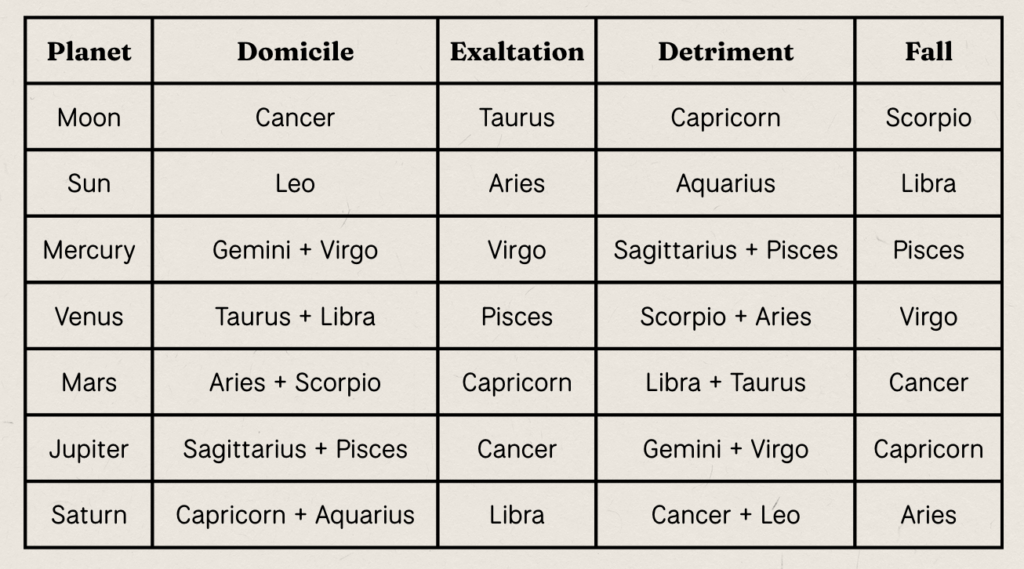
The basic premise to the dignity scheme is that each of the seven traditional planets have one (or two) signs in the zodiac that it calls “home”. This is also called rulership or domicile, and this means that the nature of the zodiac sign corresponds to the nature of the planet. When that happens, there is a quality of ease, familiarity, and autonomy. A planet in domicile is considered to be functional, since it can express its core significations without any intermediary influence. For example, Mars in Aries can act, assert itself, and stir up a fight without asking for any permission. It can play by its own rules.
“Difficult” placements in essential dignity
The opposite happens when a planet is in the sign of its detriment. Planets in detriment are in the sign opposite their home sign, which literally feels like being away from home, or exiled in a foreign country where you don’t understand the language, don’t know the cultural rules, and don’t have access to the resources and support you would have at home. In other words, with planets in detriment there is a fundamental mismatch between what the planet wants to do and what the environment (the sign) offers. For example, Mars maybe wants to assert itself and even stir up a fight, but in Libra, all of a sudden there are social rules and customs, and even the needs of other people it has to consider. There is no free play for Mars here; instead, it has to look towards Venus (the ruling planet of Libra) for guidance.
Beyond domicile and detriment, each of the planets also has a sign of exaltation and of fall. Exaltation refers to a placement where a planet is treated like an honored guest—it’s not at home, but the environment elevates and supports its function, often bringing out its best qualities and giving it special power or esteem. In contrast, a planet in fall is in the sign opposite its exaltation and is in a place of low status, lack of respect, or even disgrace. In fall, the planet’s qualities are not valued or supported, leading to feelings of being marginalised, ignored.
If you need a refresher on all of the essential dignities, here’s an overview:
Beyond the boundary of strong and weak placements
To quote astrologer Ben Dykes, planetary dignity refers to “whether planets are in a good or bad functional condition. This helps us know whether the people and events they indicate are consistent and smooth and helpful, or onruly, full of extremes, and so on.” In other words, essential dignity is very explicitly not a way to assess a planet’s moral value, but its function in the birth chart. A “strong” planet with dignity does not equal goodness, just as a “weak” planet in detriment or fall does not equal badness.
But what does that mean in practice? Say we have natal Saturn in its fall in Aries, does that mean we should just resign to our fate, accept that patience just isn’t really our strength, and work very hard to change that over time? What if there is another way of thinking about planets in detriment or fall move beyond the binary idea of “strong” (good) and “weak” (bad) placements?
Reframing difficult placements
In my practice, I believe that planets in detriment and fall have the potential to express themselves in unique, creative, and non-normative ways. Rather than seeing detriment and fall as inherently difficult, I like to reframe them as sources of resilience, innovation, and alternative strengths—challenging the status quo and expanding what is possible in astrological interpretation. This approach values difference and complexity, seeing so-called “challenging” placements as opportunities for growth, resistance, and new forms of dignity.
If you think about it, planets with essential dignity represent the status quo in a specific socio-cultural context. They have power and privilege, and do what is expected of them. While that’s great and often useful, planets with essential dignity don’t tend to surprise us. Planets in detriment and fall, on the other hand, have to figure out how to express themselves using different tools. While this may seem challenging at first, this really creates an opportunity to think outside the box and challenge the status quo. Planets in detriment and fall are not supposed to fit in. They are rebels and changemakers.
How to work with difficult placements
Planets in detriment and fall have creative, adaptive, and boundary-crossing qualities that are so deeply needed in our society. Sometimes, “not fitting in” can be a source of power, insight, and new ways of being. On top of that, it’s important to emphasise that your dignity and worth are inherent, regardless of how a planet is “supposed” to function. A very important first step in working with so-called “difficult” placements is to connect with your embodied sense of dignity: to maintain self-respect and value even when our environment or society does not reflect it back to us.
Beyond that, here are some other suggestions for how to work with difficult placements in your chart:
- Begin with curiosity and compassion. Notice how a placement shows up in your life, your body, and your relationships. The point isn’t to fix or fight it, but to understand its texture and how you might move with it.
- Look for alternative supports. A challenging placement doesn’t stand alone. You can draw on other strengths in your chart, as well as community, ritual, or therapeutic resources that help you feel resourced and steady.
- Choose nourishing environments. Seek out spaces and relationships that value difference, where the very qualities that might feel “out of place” can actually thrive.
-
Use reflective practices. Journaling, therapy, somatic work, or parts work can help you listen to what this planet needs and uncover the gifts it’s carrying.
-
Celebrate the “queerness” of the chart. A planet in fall or detriment is not simply weak. It may be resisting the norm, creating sideways strategies, or showing alternative ways of being. These placements can carry enormous creativity, insight, and resilience.
Embracing the struggle and the gift
Challenges and gifts are not separate. The very qualities that make a placement difficult — its friction, awkwardness, or resistance — often also shape its greatest strengths. A debilitated planet can be a source of critique, innovation, or change. To fully embrace these placements is to reclaim their dignity, and in doing so, reclaim our own.
If you want to explore these questions more deeply, you might enjoy my Constellate container, where we work somatically with chart placements that feel difficult, painful, or simply mysterious.


0 Comments